Showing posts with label Soviet Union. Show all posts

Wednesday, June 13, 2012

Silver Star to be Posthumously Presented to Cold War POW


Air Force Chief of Staff Gen. Norton Schwartz will posthumously award the Silver Star to Capt. Francis Gary Powers during a ceremony at the Pentagon, Friday, June 15, 2012, at 9:30 a.m. EDT in the Hall of Heroes (2D1046).

Powers, whose U-2 reconnaissance plane was shot down over the Soviet Union, May 1, 1960, will receive the medal for demonstrating "exceptional loyalty" while enduring harsh interrogation in the Lubyanka Prison in Moscow for almost two years.

Gary Powers Jr. and Dee Powers, Powers's children, and Dick Anderegg, director of Air Force History, will be available to the media for on-camera interviews in the Office of the Secretary of Defense small television studio (2E963) on June 14 from noon to 4 p.m.  Additionally, there will be a media roundtable on June 14 at 11 a.m. in the Office of the Secretary of Defense Pentagon Briefing Room (2E973).

Media wishing to attend the ceremony on June 15 or the media roundtable on June 14 should contact Air Force Public Affairs no later than 3 p.m., June 13.  Journalists without a Pentagon building pass will be picked up at the River Entrance only.  Plan to arrive no later than 45 minutes prior to the event, have proof of press affiliation and two forms of photo identification.

Please contact the Air Force Press Desk at 703-695-0640 for escort into the building.

Tuesday, January 31, 2012

Turkmenistan: Former Soviet Republic (part 2 of 2)

Continued from Part 1
 
Coat of Arms of the Turkmenistan
Soviet Socialist Republic
Part II
GOVERNMENT AND POLITICAL CONDITIONS
Although the constitution declares the country to be a secular democracy and presidential republic, Turkmenistan is an authoritarian state that was dominated by its first president, Saparmyrat Niyazov, who retained his monopoly on political power until his death on December 21, 2006. The Halk Maslahaty (People's Council) decided on December 26 to select Niyazov's successor through public elections on February 11, 2007. Gurbanguly Berdimuhamedov became president through a public election in which the population eagerly participated, even though the election did not meet international standards.
 
Government efforts continue to focus on fostering centralized state control. The president controls the parliament and the judiciary. The civilian authorities maintain effective control of the security forces. Neither independent political activity nor opposition candidates are allowed in Turkmenistan. The Democratic Party of Turkmenistan (DPT) is the only legal political party. Political gatherings are illegal unless government-sanctioned, and the citizens of Turkmenistan do not have the means to change their government democratically.
 
On November 25, 2002, an armed attack against then-President Niyazov's motorcade occurred, and the Government of Turkmenistan moved quickly against perceived sources of opposition. There were widespread reports of human rights abuses committed by officials investigating the attack, including torture and punishment of families of the accused. The Government of Turkmenistan denied the charges, but refused to allow independent observers at trials, to accept a mandatory Organization for Security and Cooperation in Europe (OSCE) fact-finding mission, or to permit the International Committee of the Red Cross (ICRC) access to prisons. It also instituted new measures to stifle dissent and limit contact with the outside world.
 
While the constitution provides for freedom of the press, there is virtually no freedom of the press or of association. The government has full control of all domestic media and restricts foreign publications. International satellite TV is widely available.
 
The population is 89% Sunni Muslim. The constitution provides for freedom of religion and does not establish a state religion; however, in practice, the government continues to monitor all forms of religious expression. Amendments to the law on religious organizations adopted in March 2004 reduced membership requirements from 500 to 5 for registration purposes. All groups must register in order to gain legal status with the government. Until 2004 the only religions that were registered successfully were Sunni Islam and Russian Orthodox Christianity. As of August 2010, 11 other religious groups were registered. The government limits the activities of unregistered religious congregations by prohibiting them from gathering publicly, proselytizing, and disseminating religious materials.
 
The government has started to review and rewrite its legislation with the stated goal of meeting international standards, including the criminal and criminal procedures codes and laws on religion and assembly. In late September 2008, a revised national constitution was adopted. It included provisions for a strengthened and enlarged Mejlis (parliament), eliminated many of former President Niyazov's arbitrary addenda, and contained some rights-related textual changes the international community had suggested. Most notably, it eliminated the Halk Maslahaty (Peoples Council), an oversized, bureaucratic, and largely rubber-stamp body whose powers have largely been transferred to the Mejlis.
 
Flag of Turkmenistan
A legacy of a Soviet-style command economy greatly limits equality of opportunity. Industry is almost entirely dominated by government or government-owned entities. Services are now largely in the private sector. Agriculture is dominated by a state order system, mainly for wheat and cotton, although about 50% of food production is in private hands.
 
In 2007, a law on state guarantees of the equal rights of women was adopted. Nonetheless, women continue to face discrimination, and their freedom is further restricted due to traditional socio-religious norms. All citizens are required to carry internal passports, noting place of residence. In July 2007, the government rescinded the requirement for citizens to acquire visas for travel to border areas.
 
Corruption is pervasive. Power is concentrated in the president. The judiciary is subservient to the president, with all judges appointed for 5-year terms by the president without legislative review.

Monday, January 30, 2012

Turkmenistan: Former Soviet Republic

Part 1 of 2
PEOPLE AND HISTORY
Flag of the Turkmenistan Soviet
Socialist Republic
The majority of Turkmenistan's citizens are ethnic Turkmen; other ethnic groups include Russian, Uzbek, and Kazakh. Turkmen is the official language of Turkmenistan, though Russian still is widely spoken as a "language of inter-ethnic communication" (per the 1992 constitution). Education is universal and mandatory through the secondary level, the total duration of which is 10 years.
 
The territory of Turkmenistan has been populated since ancient times, as armies from one empire to another decamped on their way to more prosperous territories. Tribes of horse-breeding Turkmen drifted into the territory of Turkmenistan, possibly from the Altay Mountains, and grazed along the outskirts of the Karakum Desert into Persia, Syria, and Anatolia.
 
Alexander the Great conquered the territory in the 4th century B.C. on his way to India. One hundred fifty years later the Parthian Kingdom took control of Turkmenistan, establishing its capital in Nisa, an area now located in the suburbs of the modern-day capital of Ashgabat. In the 7th century A.D. Arabs conquered this region, bringing with them the Islamic religion and incorporating the Turkmen into Middle Eastern culture. It was around this time that the famous "Silk Road" was established as a major trading route between Asia and Europe.
 
In the middle of the 11th century, the powerful Turks of the Seljuk Empire concentrated their strength in the territory of Turkmenistan in an attempt to expand into Afghanistan. The empire broke down in the second half of the 12th century, and the Turkmen lost their independence when Genghis Khan took control of the eastern Caspian Sea region on his march west. For the next 7 centuries, the Turkmen people lived under various empires and fought constant intertribal wars.
 
From the 16th century on, Turkmen raiders on horseback preyed on passing caravans, pillaging and taking prisoners for the slave trade. In order to consolidate the Tsarist Empire in Central Asia, and upon the pretext of freeing Russian citizens from slavery, Russia sent forces to Turkmenistan, and in 1881 fighting climaxed with the massacre of 7,000 Turkmen at the desert fortress of Gokdepe, near modern Ashgabat; another 8,000 were killed trying to flee across the desert. By 1894 imperial Russia had taken control of Turkmenistan. The October Revolution of 1917 in Russia and subsequent political unrest led to the declaration of the Turkmen Republic as one of the 15 republics of the Soviet Union in 1924. At this time, the modern borders of Turkmenistan were formed.
 
Following the end of the Cold War and the breakup of the Soviet Union, Turkmenistan declared its independence on October 27, 1991. Saparmyrat Niyazov became the first president of the new republic and was "president for life" until his death in 2006.

Monday, January 9, 2012

Bauer and Lenin: The Problem of Economic Calculation

By Ludwig von Mises (written in 1920)
 
Since recent events helped socialist parties to obtain power in Russia, Hungary, Germany and Austria, and have thus made the execution of a socialist nationalization program a topical issue, Marxist writers have themselves begun to deal more closely with the problems of the regulation of the socialist commonwealth. But even now they still cautiously avoid the crucial question, leaving it to be tackled by the despised "Utopians." They themselves prefer to confine their attention to what is to be done in the immediate future; they are forever drawing up programs of the path to Socialism and not of Socialism itself. The only possible conclusion from all these writings is that they are not even conscious of the larger problem of economic calculation in a socialist society.
 
To Otto Bauer the nationalization of the banks appears the final and decisive step in the carrying through of the socialist nationalization program. If all banks are nationalized and amalgamated into a single central bank, then its administrative board becomes
 
“the supreme economic authority, the chief administrative organ of the whole economy. Only by nationalization of the banks does society obtain the power to regulate its labor according to a plan, and to distribute its resources rationally among the various branches of production, so as to adapt them to the nation's needs.”
 
Bauer is not discussing the monetary arrangements which will prevail in the socialist commonwealth after the completion of the nationalization of the banks. Like other Marxists he is trying to show how simply and obviously the future socialist order of society will evolve from the conditions prevailing in a developed capitalist economy. "It suffices to transfer to the nation's representatives the power now exercised by bank shareholders through the Administrative Boards they elect, "in order to socialize the banks and thus to lay the last brick on the edifice of socialism. Bauer leaves his readers completely ignorant of the fact that the nature of the banks is entirely changed in the process of nationalization and amalgamation into one central bank. Once the banks merge into a single bank, their essence is wholly transformed; they are then in a position to issue credit without any limitation. In this fashion the monetary system as we know it today disappears of itself.
 
When in addition the single central bank is nationalized in a society, which is otherwise already completely socialized, market dealings disappear and all exchange transactions are abolished. At the same time the Bank ceases to be a bank, its specific functions are extinguished, for there is no longer any place for it in such a society.
 
This is excerpted from Economic Planning in the Socialist Commonwealth.  Read or download the entire book at the AntiMarxists Internet Archive e-library.
 
Image and book courtesy of the Ludwig von Mises Institute

Sunday, December 18, 2011

Human Rights in Belarus

Concerns About Human Rights in Belarus on the Anniversary of the December 19, 2010 Crackdown
 
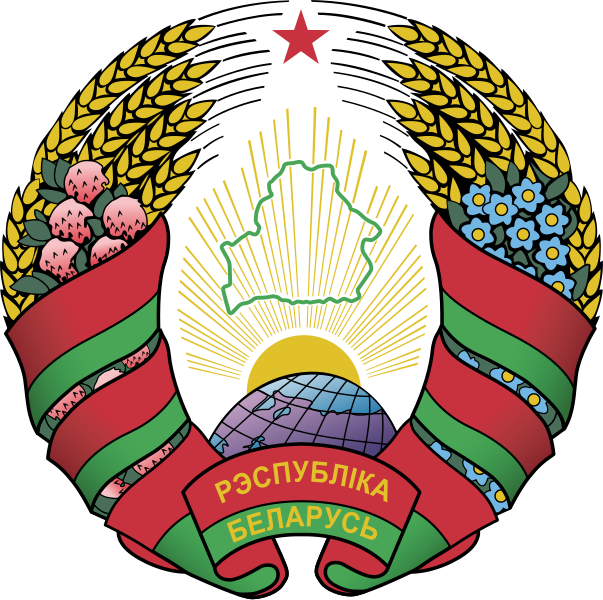
Coat of Arms of Belarus
The following is a joint statement issued by Secretary of State Hillary Rodham Clinton and EU High Representative Catherine Ashton.
 
Today we remember the one year anniversary of the start of the brutal crackdown by the Belarus Government on civil society, political opposition and independent media. Over the past 12 months, the Belarusian authorities have imprisoned peaceful demonstrators, suppressed non-violent protests, and worked to silence independent voices. There have also been credible reports of degrading and inhumane treatment of political prisoners. A number of them have been set free, but we reiterate our call for all political prisoners to be immediately released and rehabilitated, including presidential candidates Andrei Sannikau and Mikalai Statkevich, and human rights defender Ales Byalyatski. We also express grave concern over new laws that will further restrict citizens' fundamental freedoms of assembly, association and expression and that target support to civil society.
 
We reiterate that the improvement of bilateral relations with the United States and the European Union is conditional on progress by the Government of Belarus towards the fulfillment of its OSCE commitments and the respect for fundamental human rights, the rule of law and democratic principles. The United States and the European Union remain willing to assist Belarus as it works to meet these obligations.

NOTE: Since the collapse of the Soviet Union, Alexander Lukashenko has been the country's president since 1994. Under his lead and despite objections from Western governments, Soviet-era policies, such as state ownership of the economy have been continued. According to some organizations and countries, elections have been unfair, and political opponents have been violently suppressed.

Image and note courtesy of Wikipedia.

Friday, September 30, 2011

Panetta: DIA ‘Quiet Heroes’ Mark 50th Anniversary

By Cheryl Pellerin
American Forces Press Service

WASHINGTON, Sept. 29, 2011 – Every day the quiet heroes of the Defense Intelligence Agency collect, distill and distribute information that helps America’s warriors defeat its enemies, Defense Secretary Leon E. Panetta said today.

The secretary joined DIA Director Army Lt. Gen. Ronald L. Burgess Jr., Director of National Intelligence James R. Clapper, and more than 500 distinguished guests at a ceremony here celebrating the agency’s 50th anniversary.

During the ceremony, defense officials from Canada, Australia and the United Kingdom presented Burgess with gifts, and a tribute was made to fallen DIA colleagues.

“In commemorating this milestone,” Panetta said, “we all pay tribute to DIA’s half-century of extraordinary work defending our nation against a multitude of threats, a multitude of challenges, from the height of the Cold War to the post-9/11 conflicts.”

A lot has changed in the last 50 years, the secretary added, “but one thing that remains the same is that we cannot accomplish our military objectives -- it’s a fundamental principle -- … without good intelligence. The two have to work together if we’re going to achieve the ultimate victory.”

The DIA’s vital work makes the U.S. military vastly more effective and lethal, Panetta said, and America a stronger and more secure nation.

“As we take this moment to reflect on the last 50 years,” Burgess told the audience, “it is important to consider the decisions made by our nation’s leaders at a very different time and place, and how those decisions and deliberations influence our world today.”
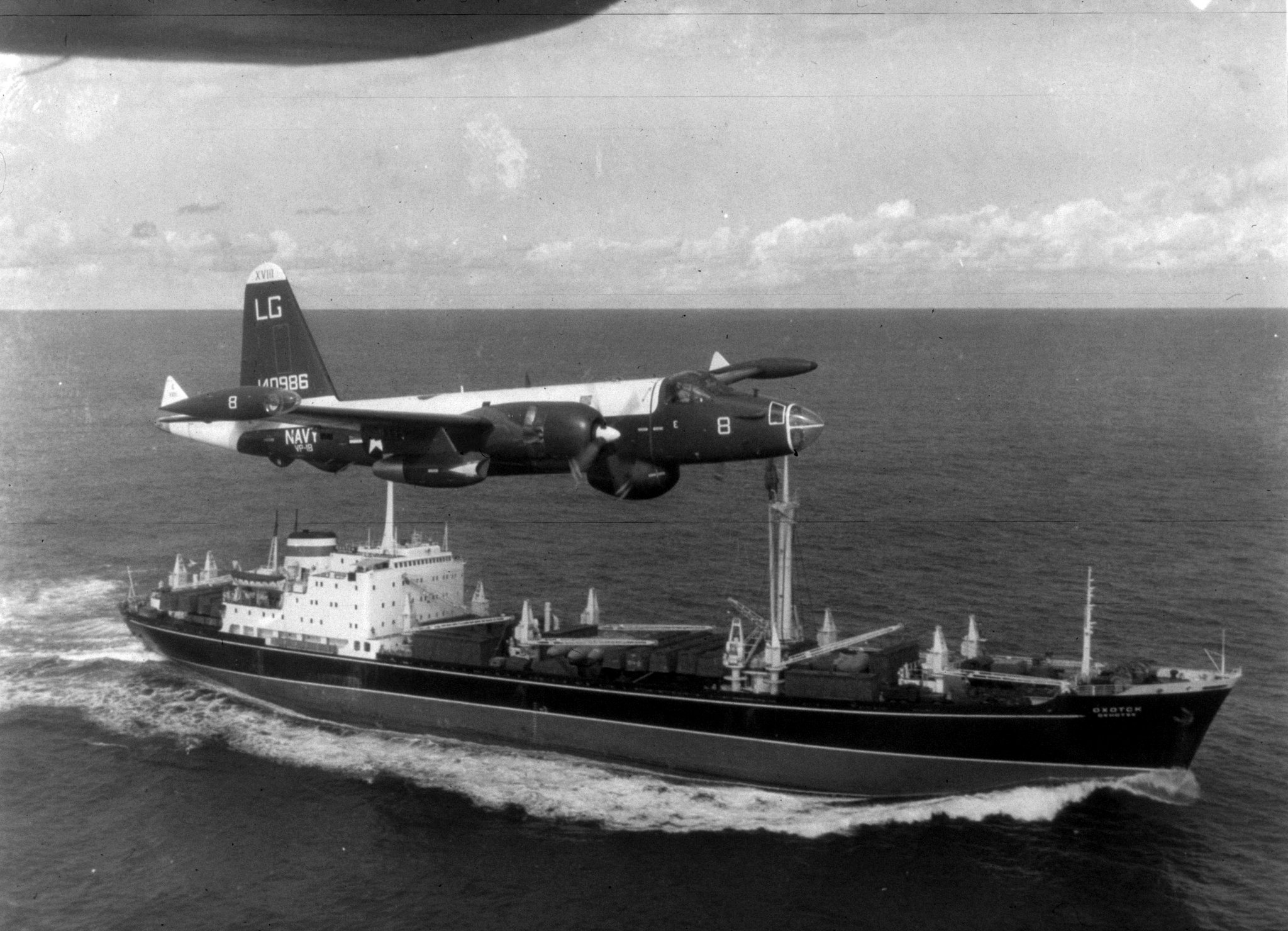
A US Navy plane flying over a Soviet
ship carrying IL-28s
In the summer of 1961, he said, during deliberations over the creation of DIA, the Joint Chiefs of Staff wrote in a report to then Defense Secretary Robert McNamara that “‘national intelligence and military intelligence are indivisible in practice.’”

Burgess added, “This important statement remains as clear, urgent, and relevant on our 50th anniversary.”

Seven former DIA directors also attended, including Clapper, who led the agency from 1992 to 1995.

“We ought to give a thought to just how fortunate we are to have not one, but two secretaries of defense in succession who both served as directors of the Central Intelligence Agency,” Clapper said, “and who obviously understand, support and care about intelligence.”

Panetta said his own DIA connection began in the mid-1960s when he was an Army intelligence officer and one of his first assignments was to the DIA office in Washington.

“Since then,” he said, “I’ve always had a great respect for the work of DIA, which has become a central part of the military and intelligence community’s efforts around the world.”

DIA was born in an era when the nation faced down a single adversary, and the potential consequences of conflict with the Soviet Union were so profound that it was critical to have the most accurate, prompt information “to prevent what we all knew would be global calamity,” Panetta said.

Less than a year later, he added, DIA faced its first great test when the Cuban missile crisis brought the world to the brink of a world war.

“I remember all of those scenes from that moment. The iconic photos of the surface-to-air missiles arranged across a Cuban airfield that provided direct evidence of the threat to our homeland,” he said.

“Those images,” the secretary added, “… shot by a U-2 reconnaissance plane, were done on flight paths determined by DIA analysis.”

Months after the crisis, Panetta said, President John F. Kennedy called on John Hughes, special assistant to the DIA director, to deliver a nationally televised briefing to reassure the nation that the Soviet missiles had been withdrawn.

“It was a moment that defined the DIA as a vital vehicle for keeping America safe,” he said. “And that sentiment is as true today as it was 50 years ago.”

Another defining moment for the United States and for the DIA was Sept. 11, 2001, Panetta said.

In the decade since the terrorist attacks, the secretary said, DIA has emerged stronger, better integrated and more integral to the fight against America’s terrorist enemies, and a driving force behind the comprehensive military-intelligence collaboration under way to defeat al-Qaida.

“We have come together as one to integrate the efforts among the DIA, DOD, CIA and all of the intelligence communities in the executive branch to become part of one great accomplishment of the post-9/11 era,” Panetta said, adding that the entire world saw the results of this teamwork with the operation that took down Osama bin Laden.

“Whether forward deployed overseas to support the war-fighting effort or from desks here in the Washington area, the men and women of the DIA stand more than ever at the center of our military’s efforts worldwide,” the secretary said.

In Iraq and Afghanistan, Panetta added, DIA has provided essential tools and intelligence for battling insurgencies and locating high-value targets.

“All the while,” he said, “DIA has remained vigilant, never taking its eye off the emerging threats we face -– monitoring North Korea’s and Iran’s nuclear ambitions, and looking at foreign military capabilities in space and cyberspace.”

This new era for DIA and the rest of the intelligence community builds on the proud traditions of the last 50 years, the secretary said, and extended to the agency his deep admiration for its achievements.

“I would like to say that as secretary of defense, and I would like to say that on behalf of the intelligence community that I had the honor to be a part of in my time here in Washington, a grateful nation … is safer and more secure due to your tireless efforts,” Panetta said.

“On behalf of the entire Department of Defense and on behalf of the American people,” he continued, “thank you for your continued outstanding devotion to duty to this country, thank you for your service, thank you for your sacrifice, thank you for all you do to protect this nation.”

If the test of DIA is whether or not it has made a difference, the secretary said, “I think that history will look at the DIA and say they did a job well done … and the result is that we have a safer and more secure life for our children in the future.”

In the end, he added, “there can be no greater legacy.”

Monday, September 26, 2011

MOU with Ukraine on Nuclear Security Cooperation

Office of the Spokesperson (State Department)
Washington, DC

Flag of the Republic of Ukraine
On September 26, Secretary Clinton signed a Memorandum of Understanding with Ukrainian Foreign Minister Gryshchenko on nuclear security cooperation. This Memorandum of Understanding formalizes the shared intent of the United States and Ukraine to implement fully the commitment that President Obama and President Yanukovych undertook at last year’s Nuclear Security Summit to work together to prevent proliferation and to secure all vulnerable nuclear material. President Yanukovych announced Ukraine’s decision to get rid of all of its stocks of highly enriched uranium by March 2012, when the next Nuclear Security Summit will convene.

The United States undertook to provide Ukraine with financial and technical assistance to help with elimination of the highly enriched uranium and to modernize Ukraine’s civil nuclear research facilities. The United States is assisting with the conversion of those facilities to operate on safer, low enriched uranium fuel and is building a state-of-the-art neutron source facility in Ukraine. In addition to new research capabilities, the neutron source facility will be able to produce over 50 different medical isotopes to treat cancer and other diseases. The facility will be equipped with the most up-to-date technology to ensure that it operates at the highest safety standards. The United States is committed to meet all agreed milestones for construction of the neutron source facility by March 2012 and to provide a fully operational facility by 2014. The estimated total value of the financial and technical assistance to be provided by the United States is expected to exceed $60 million.

We have already made significant progress toward these shared goals. Ukraine has already rid itself of a substantial portion of its highly enriched uranium and expects to complete the process early next year; the United States has made substantial progress on the neutron source facility project and expects a ground-breaking in Ukraine in the coming months. Cooperation with Ukraine on this matter is an important part of President Obama’s initiative to secure all vulnerable nuclear material worldwide.

This deal is a win-win. It provides tangible benefits for the people of Ukraine, and it makes the world a safer place to live for all people.

Note: Ukraine is a former Soviet Socialist Republic.  The United States and democratic Ukraine are working together to un-do the unvelievable nuclear arms build ups of the Cold War.

Ukrainian flag image is in the public domain. Used courtesy of Wikimedia Commons.

Tuesday, September 20, 2011

Armenia's Independence Day

The coat of arms of Soviet Armenia
Hillary Clinton

“On behalf of President Obama and the people of the United States, I am delighted to send best wishes to the people of Armenia as you celebrate the 20th anniversary of your Independence this September 21.

The United States values our relationship with Armenia, rooted in mutual respect and interests. Together, we are working to reduce poverty, expand trade and investment, promote the work of civil society groups and broaden access to healthcare. As we celebrate the bonds between our two countries and honor Armenia’s rich cultural heritage, we reaffirm the commitment of the United States to strengthen the cooperation between our two countries.

Whether you celebrate with family, friends or loved ones, know that the United States is a partner and friend. Congratulations and best wishes to all Armenians around the world for a peaceful and prosperous year to come.”

Note: Armenia’s sovereignty was hijacked by the Bolsheviks and incorporated into the Soviet Union in 1922.  Along with other Baltic states, Armenia declared independence from the USSR in 1991.
Image used above is in the public domain and was obtained from Wikimedia Commons.

Tuesday, September 13, 2011

The People’s Republic of China: A Brief History, part 1

The last dynasty in the Middle Kingdom was established in 1644, when the Manchus overthrew the native Ming dynasty and established the Qing (Ch'ing) dynasty with Beijing as its capital. At great expense in blood and treasure, the Manchus over the next half-century gained control of many border areas, including Xinjiang, Yunnan, Tibet, Mongolia, and Taiwan. The success of the early Qing period was based on the combination of Manchu martial prowess and traditional Chinese bureaucratic skills.

During the 19th century, Qing control weakened, and prosperity diminished. China suffered massive social strife, economic stagnation, explosive population growth, and Western penetration and influence. The Taiping and Nian rebellions, along with a Russian-supported Muslim separatist movement in Xinjiang, drained Chinese resources and almost toppled the dynasty. Britain's desire to continue its opium trade with China collided with imperial edicts prohibiting the addictive drug, and the First Opium War erupted in 1840. China lost the war; subsequently, Britain and other Western powers, including the United States, forcibly occupied "concessions" and gained special commercial privileges. Hong Kong was ceded to Britain in 1842 under the Treaty of Nanking, and in 1898, when the Opium Wars finally ended, Britain executed a 99-year lease of the New Territories, significantly expanding the size of the Hong Kong colony.

As time went on, the Western powers, wielding superior military technology, gained more economic and political privileges. Reformist Chinese officials argued for the adoption of Western technology to strengthen the dynasty and counter Western advances, but the Qing court played down both the Western threat and the benefits of Western technology.

Early 20th Century China
Frustrated by the Qing court's resistance to reform, young officials, military officers, and students--inspired by the revolutionary ideas of Sun Yat-sen--began to advocate the overthrow of the Qing dynasty and creation of a republic. A revolutionary military uprising on October 10, 1911, led to the abdication of the last Qing monarch. As part of a compromise to overthrow the dynasty without a civil war, the revolutionaries and reformers allowed high Qing officials to retain prominent positions in the new republic. One of these figures, Gen. Yuan Shikai, was chosen as the republic's first president. Before his death in 1916, Yuan unsuccessfully attempted to name himself emperor. His death left the republican government all but shattered, ushering in the era of the "warlords" during which China was ruled and ravaged by shifting coalitions of competing provincial military leaders.

In the 1920s, Sun Yat-sen established a revolutionary base in south China and set out to unite the fragmented nation. With Soviet assistance, he organized the Kuomintang (KMT or "Chinese Nationalist People's Party"), and entered into an alliance with the fledgling Chinese Communist Party (CCP). After Sun's death in 1925, one of his proteges, Chiang Kai-shek, seized control of the KMT and succeeded in bringing most of south and central China under its rule. In 1927, Chiang turned on the CCP and executed many of its leaders. The remnants fled into the mountains of eastern China. In 1934, driven out of their mountain bases, the CCP's forces embarked on a "Long March" across some of China's most desolate terrain to the northwestern province of Shaanxi, where they established a guerrilla base at Yan'an.

During the "Long March," the communists reorganized under a new leader, Mao Zedong (Mao Tse-tung). The bitter struggle between the KMT and the CCP continued openly or clandestinely through the 14-year-long Japanese invasion (1931-45), even though the two parties nominally formed a united front to oppose the Japanese invaders in 1937. The war between the two parties resumed after the Japanese defeat in 1945. By 1949, the CCP occupied most of the country.

Chiang Kai-shek fled with the remnants of his KMT government and military forces to Taiwan, where he proclaimed Taipei to be China's "provisional capital" and vowed to re-conquer the Chinese mainland. Taiwan still calls itself the "Republic of China."

In Beijing, on October 1, 1949, Mao Zedong proclaimed the founding of the People's Republic of China (P.R.C.). The new government assumed control of a people exhausted by two generations of war and social conflict, and an economy ravaged by high inflation and disrupted transportation links. A new political and economic order modeled on the Soviet example was quickly installed.

Continued in Part 2: The People’s Republic of China
*Spoiler Alert*  There would be another generation of war and social conflict, and an economy ravaged by high inflation and famine resulting directly from the failed policies of the Chinese Communist Party and the “Soviet model” of government.

Mao image by "Steelsnari" and used via Creative Commons Attribution-Share Alike 3.0 Unported license.  Second and third images are public domain. All three images obtained from Wikimedia Commons.

Thursday, September 8, 2011

GEORGIA: People and History

Georgia's recorded history dates back more than 2,500 years. Georgian, a South Caucasian (or "Kartvelian") language, unrelated to any outside the immediate region, is one of the oldest living languages in the world and has its own distinct alphabet. Located in the picturesque Mtkvari River valley, Georgia’s capital, Tbilisi, is more than 1,550 years old. In the early 4th century, Georgia became the second nation in the world to officially adopt Christianity. Georgia has historically been situated on the margins of great empires, and Georgians have lived together in a unified state for only a fraction of their existence as a people. Since at least the 1st century B.C. through the 18th century, much of Georgia's territory was fought over by Persian, Roman, Byzantine, Arab, Mongol, and Turkish armies. The zenith of Georgia's power as an independent kingdom came in the 11th and 12th centuries, during the reigns of King David the Builder and Queen Tamar, who rank among the most celebrated of all Georgian rulers.

In 1783, the king of Kartli (in eastern Georgia) signed the Treaty of Georgievsk with the Russians, by which Russia agreed to take the kingdom as its protectorate. In 1801, the Russian empire began the piecemeal process of unifying and annexing Georgian territory, and for most of the next 2 centuries (1801-1991) Georgia was ruled from St. Petersburg or Moscow. Exposed to modern European ideas of nationalism under Russian tutelage, Georgians, like the influential writer Ilya Chavchavadze, began calling for greater Georgian independence.

Red Army in Tbilisi, 1921
The independent Republic of Georgia was established on May 26, 1918, in the wake of the Russian Revolution. Pro-Menshevik president Noe Zhordania and a social-democratic government led the country until March 1921, when it was occupied by the Bolshevik Red Army. Georgia became a Soviet Socialist Republic the following year. Several of the Soviet Union's most well-known leaders in the 1920s and 1930s were Georgian, such as Joseph Stalin, Sergo Orjonikidze, and Lavrenti Beria, the head of Stalin’s secret police. During the Soviet period, Georgia was one of the wealthiest and most privileged republics, and its Black Sea coastline was a popular holiday destination for the Soviet elite. On April 9, 1991, shortly before the collapse of the Soviet Union, the Supreme Council of the Republic of Georgia declared independence from the U.S.S.R.

Georgian soldiers charge against an
Ossetian rebel position, 2008.
Like other former Soviet Republics, Georgia’s newly declared independence was followed by ethnic and civil strife. Secessionists took control of parts of South Ossetia and most of Abkhazia prior to cease-fire agreements brokered in 1992 and 1994, respectively. Georgia began to stabilize in 1995. However, the separatist conflicts in Georgia's regions of Abkhazia and South Ossetia remain unresolved. Periodic flare-ups in tension and violence culminated in a 5-day war in August 2008 between Georgia and Russia. French President Nicolas Sarkozy negotiated a cease-fire between Presidents Mikheil Saakashvili and Dmitriy Medvedev on August 12, 2008, which remains in effect, although Russia has not fulfilled some of its cease-fire commitments, including withdrawal of its forces to pre-war positions. As part of the Saakashvili-Medvedev cease-fire agreement, the European Union established the EU Monitoring Mission (EUMM), which patrols the undisputed Georgian side of the administrative boundary lines with Abkhazia and South Ossetia but does not have access into those regions of Georgia. The cease-fire also called for international peace talks on the situation, which have taken place regularly in Geneva since October 2008 among the EU, United Nations (UN), Organization for Security and Cooperation in Europe (OSCE), Georgia, Russia, and the United States, with the participation of de facto representatives from Abkhazia and South Ossetia.

In August 2008, Russia recognized the independence of both Abkhazia and South Ossetia. As of August 2011, only three other countries had recognized the independence of the two territories. All other countries, including the United States, have confirmed their continuing support for Georgia’s political sovereignty and territorial integrity.

Painting and Red Army photo in the public domain. Georgian soldier photo by Jonathan Alpeyrie via
Creative Commons Attribution ShareAlike 3.0 Licence. All images obtained from Wikimedia Commons.

Thursday, September 1, 2011

The Slovak Republic’s National Day

Hillary Rodham Clinton
September 1, 2011

Note: Czechoslovakia was one country ruled brutally by the Soviet Union.  The Prague Spring in 1968 brought a brief hope of democracy until the Soviet Army invaded Czechoslovakia, instated a new puppet government, and did away with the “counter-revolution.”  After the fall of the USSR, free elections resulted in the partition of Czechoslovakia as independent democratic countries: the Czech Republic and the Slovak Republic, commonly known as Slovakia.

On behalf of President Obama and the people of the United States, I congratulate the people of the Slovak Republic on the anniversary of your constitution this September 1.

Nineteen years ago, the people of Slovakia adopted an independent constitution that enabled your country’s extraordinary transition to a sustainable democracy. Today the Slovak Republic is a pillar of regional stability, a leader in economic integration, and a model for security cooperation. Our two nations share a mutual commitment to promoting freedom and defending our shared democratic values around the world. The strong cultural and familial ties between Slovakia and the United States have fostered a close partnership and an enduring friendship between our countries and our people.

As you celebrate this milestone in your democratic heritage, I wish all Slovaks continued peace and prosperity in the year to come.

Thursday, August 25, 2011

Moldova's National Day

Gheorghe Ghimpu replaces the
Soviet flag with the National
flag over Parliament. 4/1990.
Courtesy of Wiki Commons
Moldova celebrates 20 years of Independence from the Soviet Union, validating the sacrifices made by anti-Soviet resistance fighters over the years.  It has also been two years since the democratic political parties banded together to check the power grabs of the Moldovan Communist Party.

Hillary Rodham Clinton:

On behalf of President Obama and the people of the United States, I am delighted to congratulate the people of Moldova as you celebrate the 20th anniversary of your independence this August 27.

As Vice President Biden underscored during his visit to Chisinau in March, the United States remains a committed partner and friend. We are a strong supporter of Moldova’s independence, sovereignty and territorial integrity and we will continue to support you as you work towards becoming a free and prosperous part of the European community.

Over the past two decades Moldova's reforms have led to even greater peace and prosperity. I encourage Moldova's leaders to continue to find ways to expand opportunity to even more Moldovans.

Congratulations again on twenty years of independence and best wishes for a safe and joyous celebration.