Showing posts with label Germany. Show all posts

Monday, January 9, 2012

Bauer and Lenin: The Problem of Economic Calculation

By Ludwig von Mises (written in 1920)
 
Since recent events helped socialist parties to obtain power in Russia, Hungary, Germany and Austria, and have thus made the execution of a socialist nationalization program a topical issue, Marxist writers have themselves begun to deal more closely with the problems of the regulation of the socialist commonwealth. But even now they still cautiously avoid the crucial question, leaving it to be tackled by the despised "Utopians." They themselves prefer to confine their attention to what is to be done in the immediate future; they are forever drawing up programs of the path to Socialism and not of Socialism itself. The only possible conclusion from all these writings is that they are not even conscious of the larger problem of economic calculation in a socialist society.
 
To Otto Bauer the nationalization of the banks appears the final and decisive step in the carrying through of the socialist nationalization program. If all banks are nationalized and amalgamated into a single central bank, then its administrative board becomes
 
“the supreme economic authority, the chief administrative organ of the whole economy. Only by nationalization of the banks does society obtain the power to regulate its labor according to a plan, and to distribute its resources rationally among the various branches of production, so as to adapt them to the nation's needs.”
 
Bauer is not discussing the monetary arrangements which will prevail in the socialist commonwealth after the completion of the nationalization of the banks. Like other Marxists he is trying to show how simply and obviously the future socialist order of society will evolve from the conditions prevailing in a developed capitalist economy. "It suffices to transfer to the nation's representatives the power now exercised by bank shareholders through the Administrative Boards they elect, "in order to socialize the banks and thus to lay the last brick on the edifice of socialism. Bauer leaves his readers completely ignorant of the fact that the nature of the banks is entirely changed in the process of nationalization and amalgamation into one central bank. Once the banks merge into a single bank, their essence is wholly transformed; they are then in a position to issue credit without any limitation. In this fashion the monetary system as we know it today disappears of itself.
 
When in addition the single central bank is nationalized in a society, which is otherwise already completely socialized, market dealings disappear and all exchange transactions are abolished. At the same time the Bank ceases to be a bank, its specific functions are extinguished, for there is no longer any place for it in such a society.
 
This is excerpted from Economic Planning in the Socialist Commonwealth.  Read or download the entire book at the AntiMarxists Internet Archive e-library.
 
Image and book courtesy of the Ludwig von Mises Institute

Friday, January 6, 2012

Marx and the Violence of Socialism and Communism

Battle at Soufflot Barricades, 24 June 1848
by Horace Vernet
In the terminology of Marx and Engels the words communism and socialism are synonymous. They are alternately applied without any distinction between them. The same was true for the practice of all Marxian groups and sects until 1917. The political parties of Marxism which considered the Communist Manifesto as the unalterable gospel of their doctrine called themselves socialist parties. The most influential and most numerous of these parties, the German party, adopted the name Social Democratic Party. In Italy, in France and in all other countries in which Marxian parties already played a role in political life before 1917, the term socialist likewise superseded the term communist. No Marxian ever ventured, before 1917, to distinguish between communism and socialism.
 
In 1875, in his Criticism of the Gotha Programme of the German Social Democratic Party, Marx distinguished between a lower (earlier) and a higher (later) phase of the future communist society. But he did not reserve the name of communism to the higher phase, and did not call the lower phase socialism as differentiated from communism.
 
One of the fundamental dogmas of Marx is that socialism is bound to come "with the inexorability of a law of nature." Capitalist production begets its own negation and establishes the socialist system of public ownership of the means of production. This process "executes itself through the operation of the inherent laws of capitalist production." It is independent of the wills of people. It is impossible for men to accelerate it, to delay it or to hinder it. For "no social system ever disappears before all the productive forces are developed for the development of which it is broad enough, and new higher methods of production never appear before the material conditions of their existence have been hatched out in the womb of previous society."
 
This doctrine is, of course, irreconcilable with Marx's own political activities and with the teachings he advanced for the justification of these activities. Marx tried to organize a political party which by means of revolution and civil war should accomplish the transition from capitalism to socialism. The characteristic feature of their parties was, in the eyes of Marx and all Marxian doctrinaires, that they were revolutionary parties invariably committed to the idea of violent action. Their aim was to rise in rebellion, to establish the dictatorship of the proletarians and to exterminate mercilessly all bourgeois. The deeds of the Paris Communards in 1871 were considered as the perfect model of such a civil war. The Paris revolt, of course, had lamentably failed. But later uprisings were expected to succeed.
 
This is an excerpt from Planned Chaos by Ludwig von Mises.  Read or download the full book at the Anti-Marxists Internet Archive.

Book file at the AMIA e-library is courteously hosted by the Ludwig von Mises Institute. The Vernet painting is in the public domain.

Friday, September 30, 2011

Federal Republic of Germany's National Day

Hillary Rodham Clinton
Secretary of State

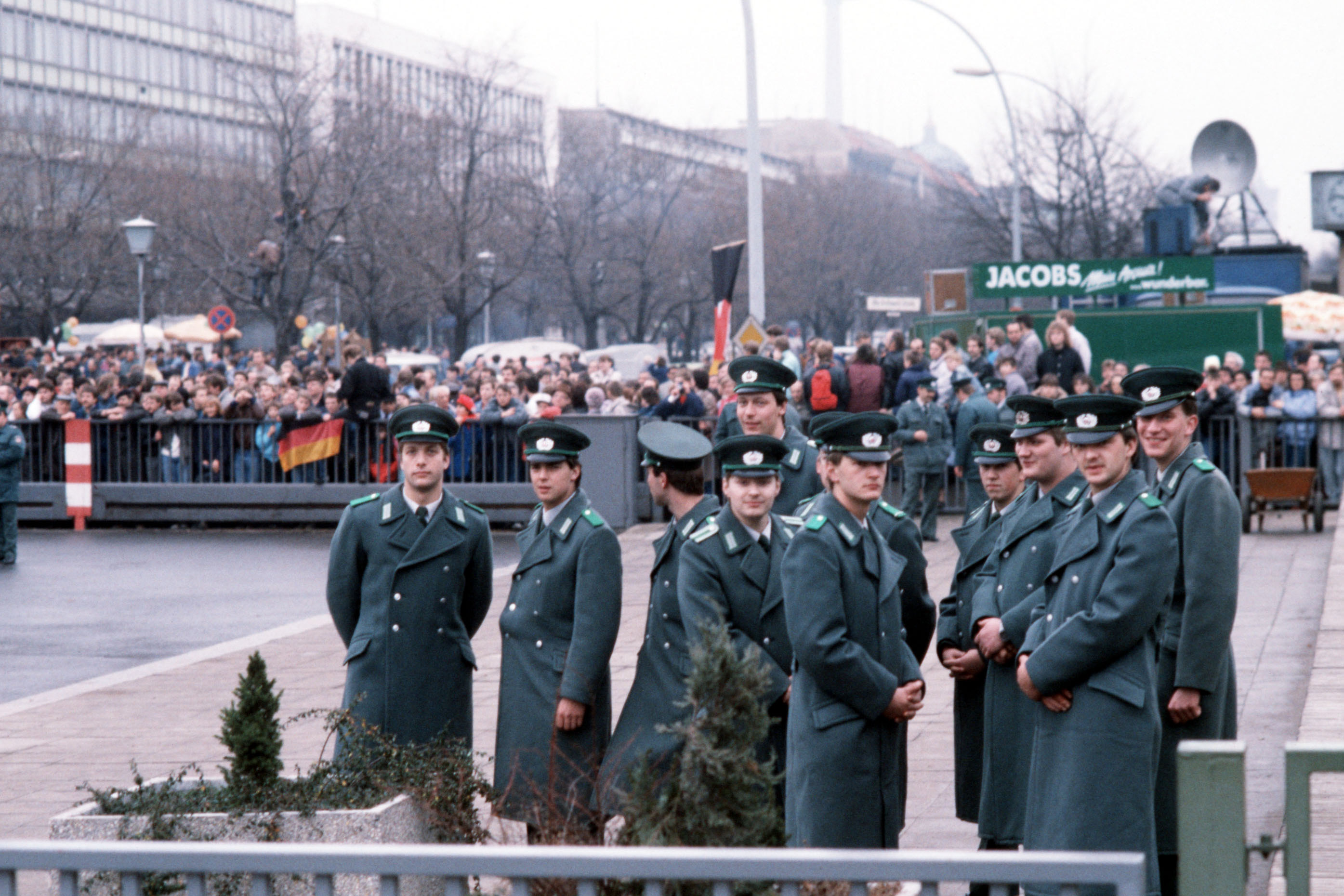
East German Volkspolizei (People's
Police) wait for the official opening of
the Brandernerg Gate, 22 DEC 1989
On behalf of President Obama and the people of the United States, I am delighted to congratulate the people of Germany as you celebrate the anniversary of German reunification this October 3. Just over 20 years ago, Germany’s reunification was not a foregone conclusion. Today, the story of Germany inspires countries around the world. You eradicated old prejudices and borders and came together as a nation. Over the last 20 years, Germany has committed to building a strong, peaceful country and you have influenced countless others to do the same. Today, you are a foundation for the European Union and NATO. In almost every corner of the globe, from the Middle East, to Asia, to South America, Germany stands as a powerful force for democracy and human rights.
Re-enactment of the V-J Day
Times Square photo by a
German couple, 12:01 AM on
Reunification night, Cologne.

I hope this anniversary is a time for every German to reflect on how far your country has come. You should be proud of the example you have set. I send my deepest congratulations and look forward to strengthening our cooperation even more as we work to build a more peaceful and prosperous world.

Note: The free and prosperous Federal Republic of Germany (West Germany) absorbed the socialist German Democratic Republic (East Germany) failed state on October 3, 1990, bringing instant job opportunities, wealth, and a higher standard of living to the beleagured citizens of the USSR's puppet state.


The Volkspolizei photo is in the public domain. Kissing photo by Gary Mark Smith, used via Creative Commons Attribution-Share Alike 3.0 Unported license.  Both were obtained from Wikimedia Commons.