Showing posts with label Peru. Show all posts

Wednesday, November 9, 2011

The Shining Path: A Brief History, Part 4

Continued from Part 3
 
The Shining Path brutally killed its victims and rejected the idea of human rights. A Shining Path document stated:
 
2009 Shining Path anti-American
propaganda poster featuring the faces
of Marx, Lenin, Mao, and Guzman
“We start by not ascribing to either Universal Declaration of Human Rights or the Costa Rica [Convention on Human Rights], but we have used their legal devices to unmask and denounce the old Peruvian state. . . . For us, human rights are contradictory to the rights of the people, because we base rights in man as a social product, not man as an abstract with innate rights. "Human rights" do not exist except for the bourgeois man, a position that was at the forefront of feudalism, like liberty, equality, and fraternity were advanced for the bourgeoisie of the past. But today, since the appearance of the proletariat as an organized class in the Communist Party, with the experience of triumphant revolutions, with the construction of socialism, new democracy and the dictatorship of the proletariat, it has been proven that human rights serve the oppressor class and the exploiters who run the imperialist and landowner-bureaucratic states. Bourgeois states in general. . . . Our position is very clear. We reject and condemn human rights because they are bourgeois, reactionary, counterrevolutionary rights, and are today a weapon of revisionists and imperialists, principally Yankee imperialists.”
--The Communist Party of Peru, Sobre las Dos Colinas
 
Level of support
While the Shining Path quickly seized control of large areas of Peru, it soon faced serious problems. The Shining Path's Maoism never had the support of the majority of the Peruvian people; according to opinion polls, 15% of the population considered subversion to be justifiable in June 1988 while 17% considered it justifiable in 1991. In June 1991, "the total sample disapproved of the Shining Path by an 83 to 7 percent margin, with 10 percent not answering the question. Among the poorest, however, only 58% stated disapproval of the Shining Path; 11 percent said they had a favorable opinion of the Shining Path, and some 31 percent would not answer the question." A September 1991 poll found that 21 percent of those polled in Lima believed that the Shining Path did not kill and torture innocent people. The same poll found that 13% believed that society would be more just if the Shining Path won the war and 22% believed society would be equally just under the Shining Path as it was under the government.
 
Many peasants were unhappy with the Shining Path's rule for a variety of reasons, such as its disrespect for indigenous culture and institutions, and the brutality of its "popular trials" that sometimes included "slitting throats, strangulation, stoning, and burning." While punishing and killing cattle thieves was popular in some parts of Peru, the Shining Path also killed peasants and popular leaders for minor offenses. Peasants were offended by the rebels' injunction against burying the bodies of Shining Path victims.
 
The Shining Path became disliked for its policy of closing small and rural markets in order to end small-scale capitalism and to starve Lima. As a Maoist organization, it strongly opposed all forms of capitalism. It followed Mao's dictum that guerrilla warfare should start in the countryside and gradually choke off the cities. As the peasants' livelihoods depended on trade in the markets, they rejected such closures. In several areas of Peru, the Shining Path launched unpopular restrictive campaigns, such as a prohibition on parties and the consumption of alcohol.
 
Government response and abuses
In 1991, President Alberto Fujimori issued a law that gave the rondas a legal status, and from that time they were officially called Comités de auto defensa ("Committees of Self Defence"). They were officially armed, usually with 12-gauge shotguns, and trained by the Peruvian Army. According to the government, there were approximately 7,226 comités de auto defensa as of 2005; almost 4,000 are located in the central region of Peru, the stronghold of the Shining Path.
 
The Peruvian government also clamped down on the Shining Path in other ways. Military personnel were dispatched to areas dominated by the Shining Path, especially Ayacucho, to fight the rebels. Ayacucho itself was declared an emergency zone, and constitutional rights were suspended in the area.
 
Civilian victims of the Shining Path
Initial government efforts to fight the Shining Path were not very effective or promising. Military units engaged in many human rights violations, which caused the Shining Path to appear in the eyes of many as the lesser of two evils. They used excessive force and killed many innocent civilians. Government forces destroyed villages and killed campesinos suspected of supporting the Shining Path. They eventually lessened the pace at which the armed forces committed atrocities such as massacres. Additionally, the state began the widespread use of intelligence agencies in its fight against the Shining Path. However, atrocities were committed by the National Intelligence Service and the Army Intelligence Service, notably the La Cantuta massacre and the Barrios Altos massacre, both of which were committed by Grupo Colina.
 
After the collapse of the Fujimori government, interim President Valentín Paniagua, established a Truth and Reconciliation Commission to investigate the conflict. The Commission found in its 2003 Final Report that 69,280 people died or disappeared between 1980 and 2000 as a result of the armed conflict. About 54% of the deaths and disappearances reported to the Commission were caused by the Shining Path. A statistical analysis of the available data led the Truth and Reconciliation Commission to estimate that the Shining Path was responsible for the death or disappearance of 31,331 people, 46% of the total deaths and disappearances. According to a summary of the report by Human Rights Watch, "Shining Path… killed about half the victims, and roughly one-third died at the hands of government security forces… The commission attributed some of the other slayings to a smaller guerrilla group and local militias. The rest remain unattributed." The MRTA was held responsible for 1.5% of the deaths.
 
Continued in Part 5: The Shining Path’s collapse and resurgence
Information courtesy of Wikipedia. Propaganda poster was obtained via TrevorLoudon.com and victims photograph was obtained via Neveryetmelted.com .

Monday, November 7, 2011

The Shining Path: A Brief History, Part 3

Continued from Part 2

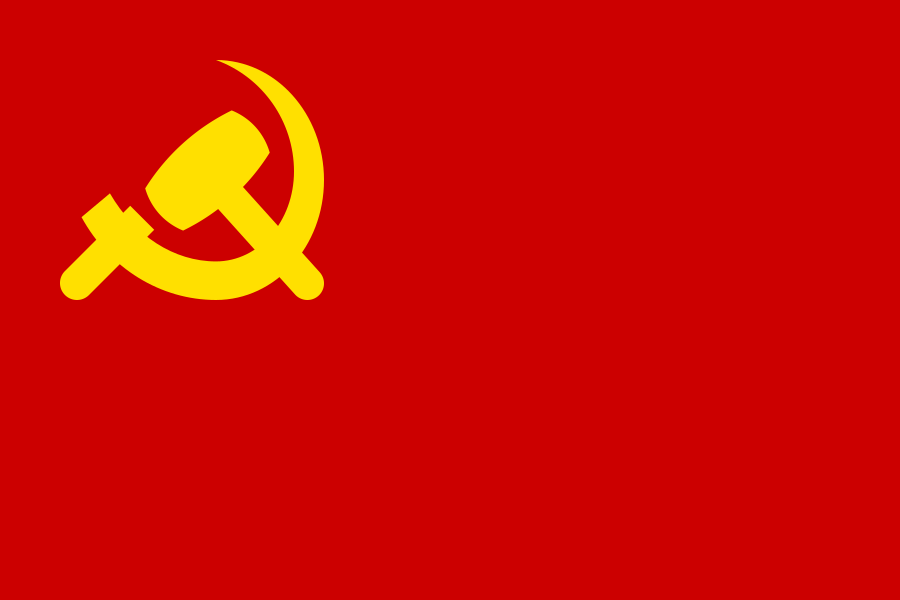
Flag of the Communist Party of Peru
(The Shining Path)
In response [to the execution of Curitomay by peasant militias in a defensive campaign], in April the Shining Path entered the province of Huanca Sancos and the towns of Yanaccollpa, Ataccara, Llacchua, Muylacruz and Lucanamarca, where they killed 69 people, in what became known as the Lucanamarca massacre. This was the first time the Shining Path massacred peasants. Similar events followed, such as the ones in Hauyllo, Tambo District. The guerrillas killed 47 peasants, including 14 children aged four to fifteen. Additional massacres by the Shining Path occurred, such as the one in Marcas on August 29, 1985. In addition to occasional massacres, the Shining Path established labor camps to punish those who betrayed the "forces of the people." Those imprisoned were forced to work the lands and the coca fields. Hunger and deprivation were commonplace, and attempting escape was punishable by immediate execution.
 
The Shining Path's attacks were not limited to the countryside. It mounted attacks against the infrastructure in Lima, killing civilians in the process. In 1983, it sabotaged several electrical transmission towers, causing a citywide blackout, and set fire and destroyed the Bayer industrial plant. That same year, it set off a powerful bomb in the offices of the governing party, Popular Action. Escalating its activities in Lima, in June 1985 it blew up electricity transmission towers in Lima, producing a blackout, and detonated car bombs near the government palace and the justice palace. It was believed to be responsible for bombing a shopping mall. At the time, President Fernando Belaúnde Terry was receiving the Argentine president Raúl Alfonsín. In one of its last attacks in Lima, on July 16, 1992, the group detonated a powerful bomb on Tarata Street in the Miraflores District, full of civilian people, adults and children, killing 25 people and injuring an additional 155.
 
During this period, the Shining Path assassinated specific individuals, notably leaders of other leftist groups, local political parties, labor unions, and peasant organizations, some of whom were anti-Shining Path Marxists. On April 24, 1985, in the midst of presidential elections, it tried to assassinate Domingo García Rada, the president of the Peruvian National Electoral Council, severely injuring him and mortally wounding his driver. In 1988, Constantin Gregory, an American citizen working for the United States Agency for International Development, was assassinated. Two French aid workers were killed on December 4 that same year. In August 1991, the group killed one Italian and two Polish priests in Ancash Region. The following February, it assassinated María Elena Moyano, a well-known community organizer in Villa El Salvador, a vast shantytown in Lima.
Flag of the MRTA, another Peruvian
Marxist guerrilla army and enemy of
the Shining Path
By 1991, the Shining Path had control of much of the countryside of the center and south of Peru and had a large presence in the outskirts of Lima. As the organization grew in power, a cult of personality grew around Guzmán. The official ideology of the Shining Path ceased to be 'Marxism–Leninism-Mao Tse-tung thought', and was instead referred to as 'Marxism–Leninism–Maoism-Gonzalo thought'. The Shining Path fought against Peru's other major Marxist guerrilla group, the Túpac Amaru Revolutionary Movement (MRTA) and campesino (peasant) self-defense groups organized by the Peruvian armed forces.
 
Although the reliability of reports regarding the Shining Paths alleged atrocities remain a matter of controversy, the organization's use of violence is well documented. Lisa North, an expert on Peru at York University, noted that "the assassinations they carried out were absolutely ruthless . . . It was so extremist – absolutely, totally doctrinaire and absolutely, totally ruthless in pursuit of its aims."
 
The Shining Path brutally killed its victims and rejected the idea of human rights.
 
Continued in Part 4: The flat denial of human rights and loss of popularity
Both images property of "Huhsunqu" and used via Creative Commons Attribution-Share Alike 2.5 Generic license.

Thursday, November 3, 2011

The Shining Path: A Brief History, part 2

Continued from Part 1
 
 
Guerrilla War
When Peru's military government allowed elections for the first time in a dozen years in 1980, the Shining Path was one of the few leftist political groups that declined to take part. It chose to begin guerrilla war in the highlands of Ayacucho Region. On May 17, 1980, the eve of the presidential elections, it burned ballot boxes in the town of Chuschi. It was the first "act of war" by the Shining Path. The perpetrators were quickly caught, additional ballots were shipped to Chuschi, the elections proceeded without further incident, and the incident received little attention in the Peruvian press.
 
 
Shining Path propaganda
poster celebrating 5 years
of civil war (People's War)
Abimael Guzmán stated that "the triumph of the revolution will cost a million lives" - at a time when Peru's population was only 19 million. To that end, the Shining Path attempted to eradicate elements of the political and social order, attacking community leaders, teachers and professors, and political leaders. The first case of "popular justice" was the assassination in December 1980 of Benigno Medina, a landowner. In January 1982, two teachers were executed in front of their students. Several months later, 67 "traitors" were subjected to public execution. In addition, they set about demolishing all government installations and infrastructure. In August 1982, they destroyed the Center for Agricultural Research and Experimentation in Allpahaca and killed the animals.
 
 
Throughout the 1980s, the Shining Path grew in both the territory it controlled and the number of militants in its organization, particularly in the Andean highlands. It gained support from local peasants by filling the political void left by the central government and providing popular justice. This caused the peasantry of many Peruvian villages to express some sympathy for the Shining Path, especially in the impoverished and neglected regions of Ayacucho, Apurímac, and Huancavelica. At times, the civilian population of small neglected towns participated in popular trials, especially when the victims of the trials were widely disliked.
 
 
The Shining Path's credibility was helped by the government's initially tepid response to the insurgency. For over a year, the government refused to declare a state of emergency in the region where the Shining Path was operating. The Interior Minister, José María de la Jara, believed the group could be easily defeated through police actions. Additionally, the president, Fernando Belaúnde Terry, who returned to power in 1980, was reluctant to cede authority to the armed forces, as his first government had ended in a military coup. The result was that the peasants in the areas where the Shining Path was active thought the state was impotent or not interested in their issues.
 
 
On December 29, 1981 the government declared an "emergency zone" in the three Andean regions of Ayacucho, Huancavelica and Apurímac, and granted the military the power to arbitrarily detain any suspicious person. The military abused this power, arresting scores of innocent people, at times subjecting them to torture during interrogation and rape. Police, military forces and members of the People’s Guerrilla Army (Ejército Guerrillero Popular, or EGP) carried out several massacres throughout the conflict. Military personnel took to wearing black ski-masks to hide their identities and protect their safety and that of their families. But the masks were intimidating, and also hid the identities of military personnel as they committed crimes.
 
 
In some areas, the military trained peasants and organized them into anti-rebel militias, called rondas. They were generally poorly-equipped, despite being provided arms by the state. The rondas attacked the Shining Path guerrillas. The first such reported attack was in January 1983 near Huata, when ronderos killed 13 senderistas; in February in Sacsamarca. In March 1983, ronderos brutally killed Olegario Curitomay, one of the commanders of the town of Lucanamarca. They took him to the town square, stoned him, stabbed him, set him on fire, and finally shot him.
 
 
In response, in April the Shining Path entered the province of Huanca Sancos and the towns of Yanaccollpa, Ataccara, Llacchua, Muylacruz and Lucanamarca, where they killed 69 people, in what became known as the Lucanamarca massacre. This was the first time the Shining Path massacred peasants.
 
 
Continued in Part 3: Terrorism and the Guzman Personality Cult

Information and image courtesy of Wikipedia.

Saturday, October 29, 2011

The Shining Path: A Brief History

Shining Path (Sendero Luminoso in Spanish) is a Maoist insurgent guerrilla organization in Peru. The group never refers to itself as "Shining Path", and as several other Peruvian groups, prefers to be called the "Communist Party of Peru" or "PCP-SL" in short. The Shining Path initiated the internal conflict in Peru in 1980, with the stated goal of replacing what it saw as bourgeois democracy with "New Democracy". The Shining Path believed that by imposing a dictatorship of the proletariat, inducing cultural revolution, and eventually sparking world revolution, they could arrive at pure communism. The Shining Path said that existing socialist countries were revisionist, and that it was the vanguard of the world communist movement. The Shining Path's ideology and tactics have been influential on other Maoist insurgent groups, notably the Communist Party of Nepal (Maoist) and other Revolutionary Internationalist Movement-affiliated organizations.
 
 
Widely condemned for its brutality, including violence deployed against peasants, trade union organizers, popularly elected officials and the general civilian population, the Shining Path is described by the Peruvian government as a terrorist organization. The group is on the U.S. Department of State's list of Foreign Terrorist Organizations, and the European Union and Canada likewise describe it as a terrorist organization and prohibit providing funding or other financial support.
 
 
Origins
The Shining Path was founded in the late 1960s by former university philosophy professor Abimael Guzmán (referred to by his followers by his nom de guerre Presidente Gonzalo)[citation needed], whose teachings created the foundation for its militant Maoist doctrine. It was an offshoot of the Communist Party of Peru — Bandera Roja (red flag), which in turn split from the original Peruvian Communist Party, a derivation of the Peruvian Socialist Party founded by José Carlos Mariátegui in 1928.
 
 
The Shining Path first established a foothold at San Cristóbal of Huamanga University, in Ayacucho, where Guzmán taught philosophy. The university had recently reopened after being closed for about half a century, and many students of the newly educated class adopted the Shining Path's radical ideology. Between 1973 and 1975, Shining Path members gained control of the student councils in the Universities of Huancayo and La Cantuta, and developed a significant presence in the National University of Engineering in Lima and the National University of San Marcos, the oldest university in the Americas. Sometime later, it lost many student elections in the universities, including Guzmán's San Cristóbal of Huamanga. It decided to abandon recruiting at the universities and reconsolidate.
 
 
Beginning on March 17, 1980, the Shining Path held a series of clandestine meetings in Ayacucho, known as the Central Committee's second plenary. It formed a "Revolutionary Directorate" that was political and military in nature, and ordered its militias to transfer to strategic areas in the provinces to start the "armed struggle". The group also held its "First Military School" where members were instructed in military tactics and weapons use. They also engaged in the "Criticism and Self-criticism", a Maoist practice intended to purge bad habits and avoid repeating mistakes. During the First Military School, members of the Central Committee came under heavy criticism. Guzmán did not, and he emerged from the First Military School as the clear leader of the Shining Path.
 
 
Continued in Part 2: “The triumph of the Revolution will cost a million lives”
Information and image courtesy of Wikipedia.